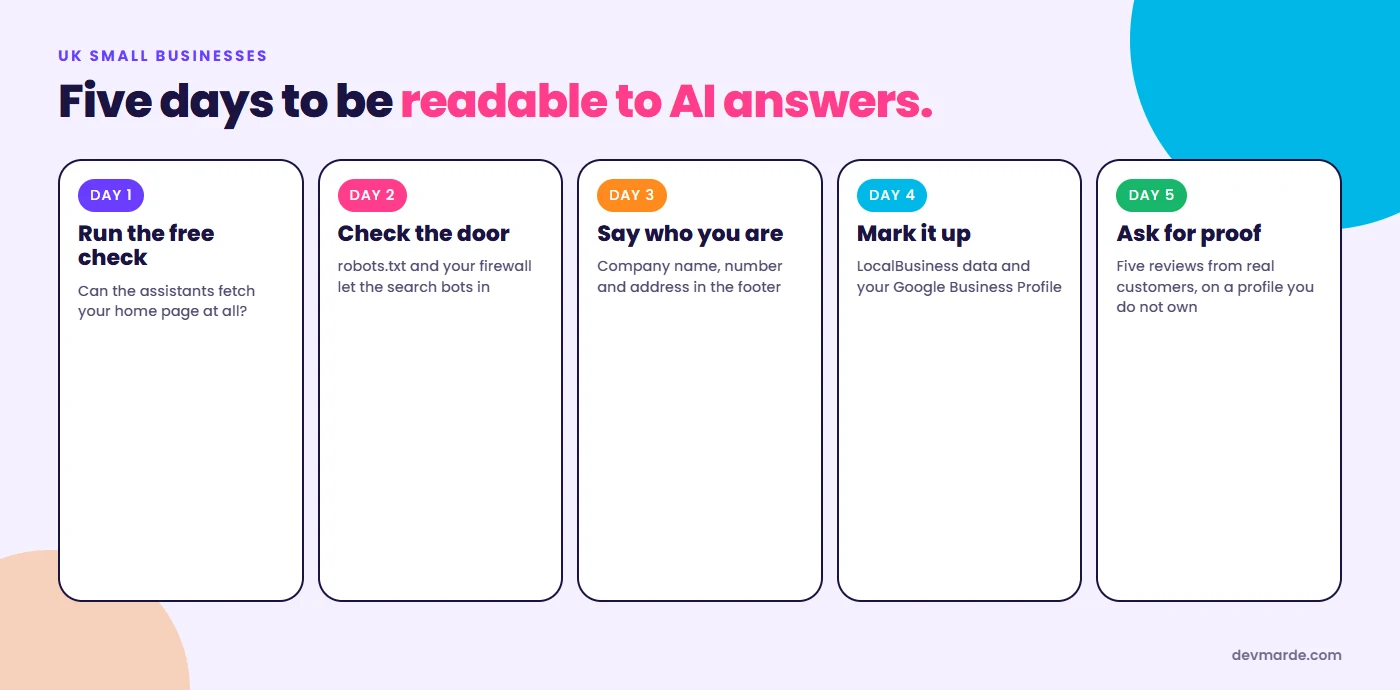
Short answer: if you run a UK small business and want ChatGPT, Claude, Perplexity and Google's AI answers to be able to mention you, you need five things in this order: the bots can fetch your site, your company details are on it, your business is marked up so a machine can read it, your Google Business Profile is complete, and some real customers have said something about you somewhere you do not control. You can do the first three in a day or two. The last two take longer, and they are the ones that decide whether you are mentioned.
Where this guide comes from
I am Zain Kazmi, and DevMarDe is a UK registered company with a studio in Lahore. Our own site is the test bed: we run the same checks on it that we run for clients, and everything below is something you can verify against the sources at the end. I am not promising a ranking. Nobody outside the AI companies can, and what they do with a page is not published.
Day 1: find out whether the bots can read you at all
Run the free Crawl Audit check on your home page. It takes a minute and needs no sign-up. It tells you whether the main AI crawlers can fetch the page and whether the page carries the basics. If it comes back clean, you are ahead of a lot of sites. If it does not, the next day is for that.
Day 2: let the search bots in
Two things can say no. Your robots.txt can, and so can a firewall or security plugin in front of your site, even when robots.txt says yes. Open yourdomain.co.uk/robots.txt and check that you have not disallowed OAI-SearchBot, Claude-SearchBot, PerplexityBot or Googlebot. Then check your host or security plugin, because UK hosts and WordPress security plugins sometimes block bots by default. Our guides cover both sides: which bot is which and what to allow, and how a firewall blocks them by accident.
Day 3: show who you are, the way GOV.UK expects
This is the step that is specific to the UK, and it is useful for two reasons. It is a legal requirement for limited companies, and it is also the sort of plain, checkable detail that lets a machine be sure which business a page is about.
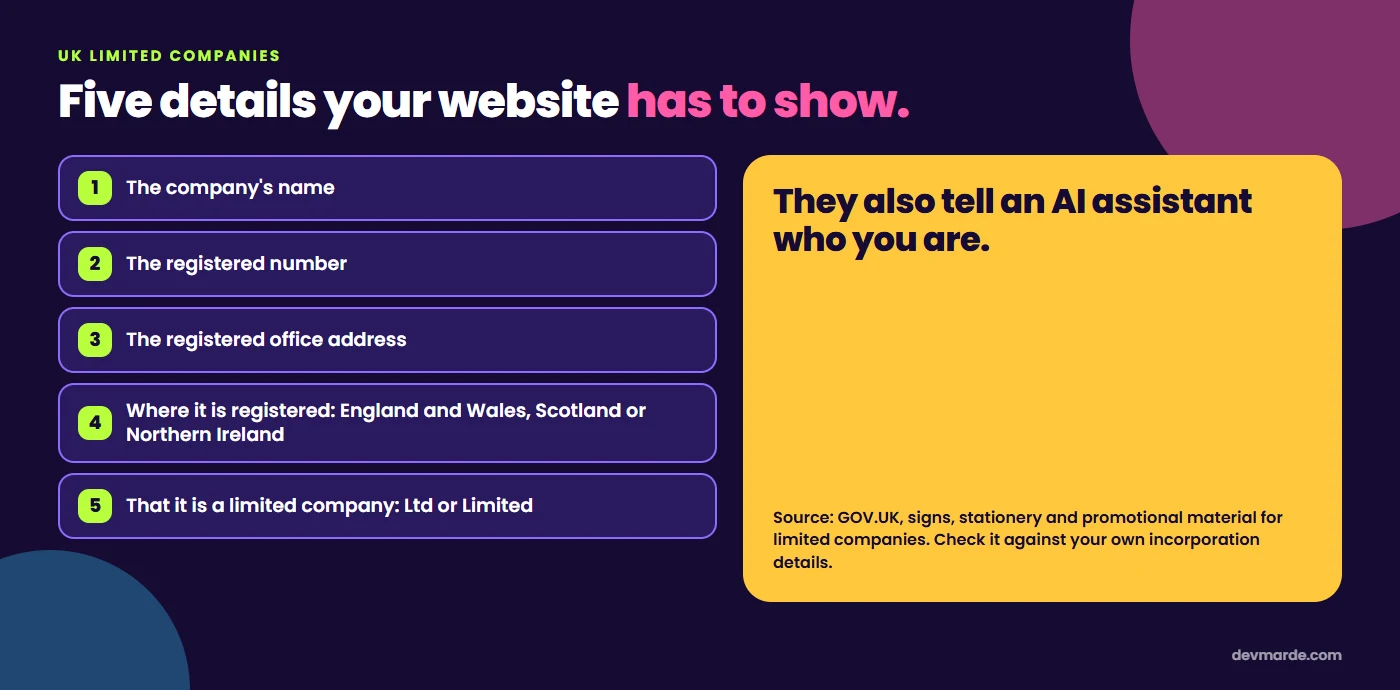
GOV.UK says a limited company's website must show the company name, its registered number, its registered office address, where it is registered (England and Wales, Scotland or Northern Ireland) and that it is a limited company. Put them in your footer, and repeat them on your contact page. Check them against your Companies House record, because a mismatch is worse than leaving them out. If you are a sole trader or a partnership the rule differs, so read the GOV.UK page for your structure before you copy this.
For reference, ours is registered in England and Wales and the record is public on Companies House.
Day 4: mark up the business and finish the Google profile
Structured data. A short block of LocalBusiness markup on your home page or contact page tells a machine your name, address, phone number, opening hours and website in a form it does not have to guess at. Google's documentation says name and address are required for this type. Use the same name, address and phone number you use everywhere else, character for character, because mismatches are the commonest way for a small business to look like two businesses. Our free schema generator writes the block for you.
One warning, because it catches people out: do not add star ratings to your own LocalBusiness markup. Google's guidelines treat reviews of a business marked up on the business's own site as self-serving, and they are not eligible for review rich results. We explain that in our guide to review schema for service businesses.
Google Business Profile. Fill every field: categories, services, opening hours, a description in plain words, photos of the real premises or work, and the website link. It is the source many local answers lean on, and it is free. Keep the name, address and phone identical to your site.
Day 5: get proof somewhere you do not own
An AI answer that recommends a business is usually drawing on what other places say about it. Your own site saying you are good is the weakest version. Ask five real customers, this week, to leave a review on your Google Business Profile, and a trade or industry directory that matters in your field. Do not offer anything in exchange for a good one, and do not write them yourself. Google's rules prohibit fake and undisclosed incentivised reviews, and a profile with five real reviews beats one with fifty you would have to explain.
After the first week
- Write the pages your customers' questions deserve, one question per page, answered in the first two sentences.
- Get mentioned by something other than yourself: a local newspaper, a trade body, a supplier's "our customers" page.
- Check again in a month. Run the Crawl Audit again and read your server logs for the search bots.
The longer version of this plan is our complete guide to AI search optimization. If you would rather hand the technical part over, our AI visibility service covers days 1 to 4, and the Fix is priced up to $490 from your report.
Questions people ask
Do I need to be a limited company for this to work?
No. The company details rule on GOV.UK applies to limited companies. A sole trader should show their name and a contact address instead, and the markup and profile steps are the same.
Is AI search optimisation the same as SEO?
They overlap. A page that cannot be crawled or understood does badly in both. The difference is that AI answers often draw on several sources and name only a few, so being clearly described and mentioned elsewhere counts for more than keywords on a page.
Which matters more, my website or my Google Business Profile?
For a local business you need both, and they must agree. The profile is where many local answers start, and the website is where the bots check the details.
How long before ChatGPT or Google mentions my business?
Nobody can say, and anyone who gives you a date is guessing. Search bots need to fetch your pages first, which takes days to weeks, and then a model has to decide you are a good answer.
Do UK businesses need to do anything different from US ones?
Mostly the company details above and UK address formats, plus using the same business name on Companies House, your site and your profile. The crawler access and markup steps are identical.
Sources
- GOV.UK, Signs, stationery and promotional material for limited companies, read 15 October 2026
- Google Search Central, Local business structured data, read 15 October 2026
- Google Search Central, Review snippet, read 15 October 2026
- Companies House, company 14258316
Related
View all →AI crawler user agents: what to allow, from GPTBot to ClaudeBot
Every AI crawler name you will see in your logs, what each one is for, which to allow if you want to be found in AI answers, copy-paste robots.txt rules, and the test we ran on our own site.
llms.txt for Shopify and WordPress: how to add it
What llms.txt is, the four-part format, a template you can copy, how to put it at /llms.txt on Shopify and WordPress, and what the big AI companies say about it.
How to tell if AI search optimization is working
Six free ways to measure AI search optimization, in the order to check them: Google and Bing AI reports, ChatGPT referrals, crawler logs and a prompt panel.
Find out whether AI answers can read your site.
Crawl Audit scores your own domain against the signals in this guide. The free check needs no sign-up; the full report is $7.89, one time.