Short answer: your Search Console graph is probably telling you two different things, and most people read it as one. Google now answers many questions above the results, so even a top spot gets far fewer clicks than it used to. And if you sit on page three or four, you were never going to get clicks in the first place. The first one is a market change. The second one is yours to fix this week.
The 2026 number, and it is a big one
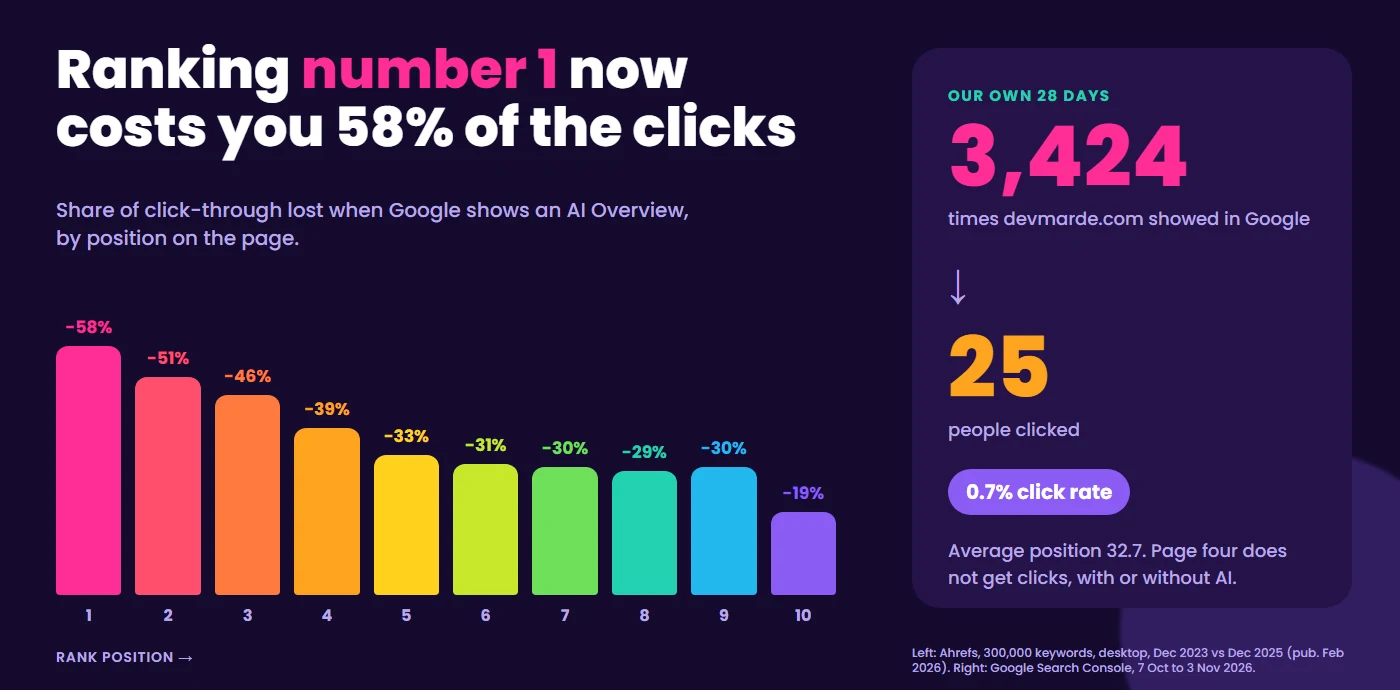
In February 2026 Ahrefs re-ran its AI Overview study on 300,000 keywords. Half had a Google AI Overview, half were similar searches without one. Comparing December 2023 with December 2025 on desktop, the average click rate for the number one result was 58% lower on searches with an AI Overview. It went from 0.073 to 0.016. The searches without one fell too, from 0.076 to 0.039, so part of the slide is everywhere. The gap between the two is the AI part.
Their earlier study, published in April 2025, put the drop at 34.5%. Ten months later it was 58%. That is the trend, and it is moving the wrong way for anyone who lives on clicks.
Two cautions that Ahrefs states or that follow from the design. This is a correlation, not proof that the overview caused every lost click. And it is desktop only, so it says nothing about phones. Still, I would not wait for a better study before changing how I work.
It hurts at every position, but not equally
Here is the drop in click rate by position, from the same study.
- Position 1: 58.0% lower
- Position 2: 50.8%
- Position 3: 46.4%
- Position 4: 38.8%
- Position 5: 32.6%
- Positions 6 to 9: between 28.8% and 30.5%
- Position 10: 19.4%
The better you rank, the more an AI answer costs you. That is the odd part. The prize at the top got smaller faster than the prize lower down, so "just rank number one" is no longer a plan on its own.
Our own numbers, which are worse
Over the 28 days from 7 Oct to 3 Nov 2026, devmarde.com had 3,424 impressions in Google and 25 clicks. That is about 0.7%, at an average position of 32.7. Position 32 is page four. Nobody scrolls there, so the low clicks were never a mystery once I put the position next to them. AI Overviews are not why we got 25.
The impressions themselves came mostly from a spike in early November, when our long pillar guide started showing for broad head terms. Plenty of eyeballs on the results page, nobody on the site. The clicks we did get landed on narrow pages that answered one specific question.
I would rather publish that than pretend. If your own graph looks like this, you are in the majority, and the fix below is cheap.
Which problem do you have?
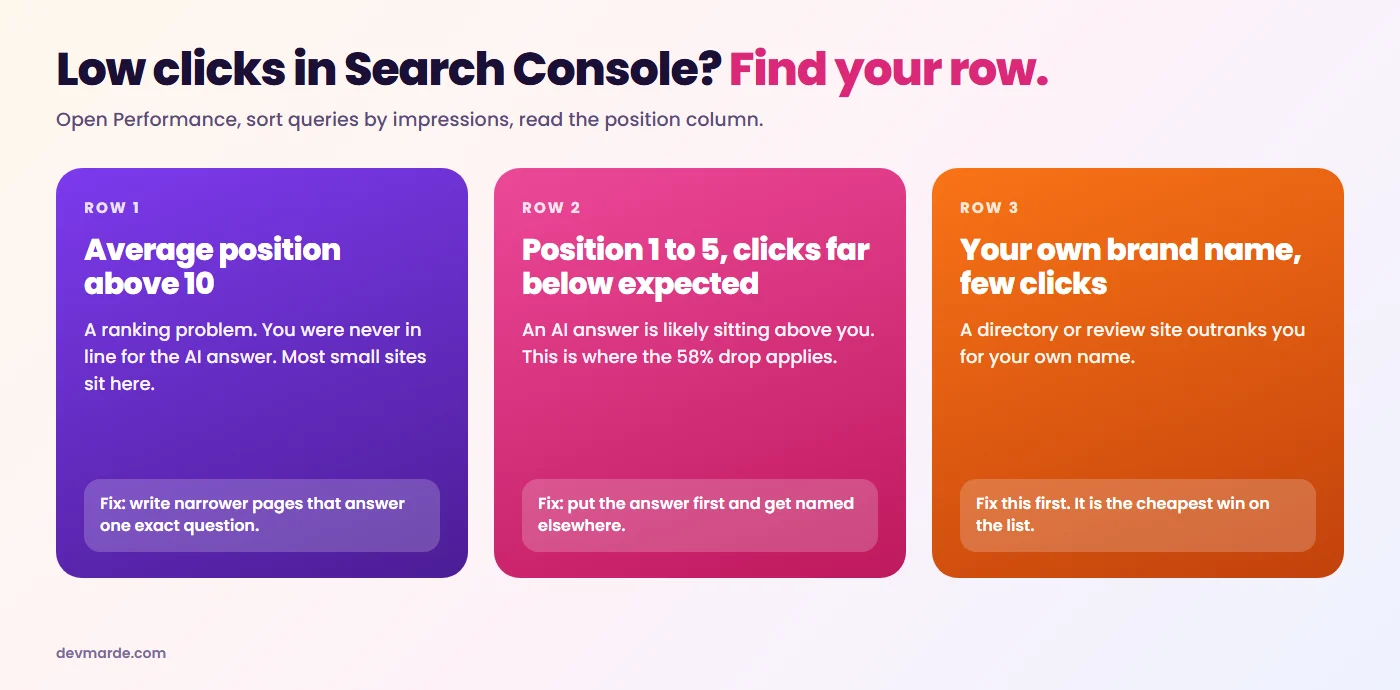
Open Search Console, go to Performance, sort queries by impressions, and look at the position column.
- Average position above 10 with low clicks: a ranking problem. No AI feature is taking your clicks because you were never in line for them. Most small sites are here.
- Position 1 to 5 with a click rate far below what you expected: this is where an AI answer is likely sitting above you, and where the table above applies.
- Branded queries with low clicks: somebody else's page, a directory or a review site, is outranking you for your own name. Fix this first, it is the cheapest win on the list.
What to change this week
1. Write the narrow page, not the broad one
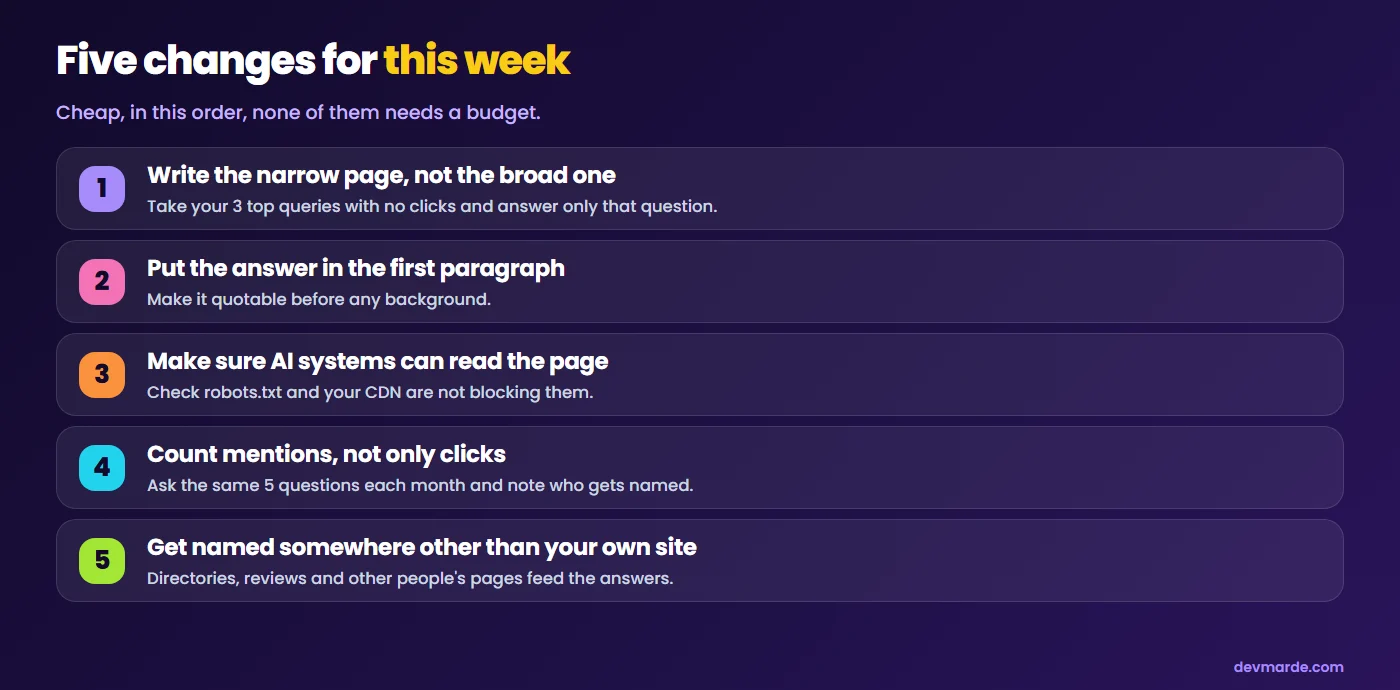
A page chasing "AI search optimisation" competes with every agency on earth. A page that answers "should I block GPTBot in Cloudflare" competes with a handful. Take your three highest-impression queries with no clicks and ask what exact question the searcher had. Write one page that answers only that.
2. Put the answer in the first paragraph
AI answers pull from pages that state the answer plainly near the top, and a human deciding in one second to stay needs the same thing. If your page opens with three paragraphs of background, move the answer up. We did this to every post on this site, including how to prioritize AI search fixes.
3. Make sure AI systems can read the page at all
If a firewall blocks the bots, you cannot be named in an answer. Our guide on Cloudflare blocking AI bots covers the one setting most small sites never check, and the list of AI crawler user agents tells you which to allow. The free Crawl Audit checks your homepage in a minute.
4. Count mentions, not only clicks
When the answer happens on the results page, a click is no longer the only sign someone saw you. Being named counts, and Search Console does not show it. Our post on how to measure AI search optimization shows a simple way: ask the same five questions in ChatGPT and Perplexity every month and write down who gets named. The citation tracker does the same check for you.
5. Get named somewhere other than your own site
Studies of what ChatGPT recommends keep finding that outside pages matter more than a business's own website: comparison lists, reviews, community threads. Which sources count most changes month to month, and most of those studies are run by companies that sell visibility, so I would not bet on one channel. What holds across them is that being described correctly in several places beats being perfect in one. Start where a customer would look for you, and keep the name, address and one-line description identical. The sameAs schema guide shows how to tie those profiles back to your site.
What I would not do
I would not rewrite the whole site because a graph went the wrong way, and I would not trust anyone who promises you a top spot as the answer. Our 3,424 impressions told us something useful: Google had started showing us, for the wrong questions, on page four. That is a writing job, one narrow page at a time, not a redesign.
A check to run today
Export your top 20 queries by impressions. Mark each one broad, specific or brand. Pick the biggest broad one with zero clicks and write down the exact question behind it. If you can answer it in two sentences, you have the first line of your next page. If you cannot, that is the reason nobody clicks.
For the wider picture, read the complete guide to AI search optimization.
Related
View all →How to tell if AI search optimization is working
Six free ways to measure AI search optimization, in the order to check them: Google and Bing AI reports, ChatGPT referrals, crawler logs, a prompt panel and a free citation tracker.
How to prioritize AI search fixes: what to do first
Not sure where to start with AI search? The order that works: let bots in, make the page readable, state who you are, then earn mentions. Fix the first one first.
AI crawl audit tools compared: Crawl Audit, crawlaudit.tech, Parsigo, CrawlerCheck and CrawlCheck
Five free and paid tools that check whether AI crawlers can reach your site, compared on what each one says it checks, what it costs, whether it needs sign-up and who makes it. Read from each tool's own site on 26 October 2026.
Find out whether AI answers can read your site.
Crawl Audit scores your own domain against the signals in this guide. The free check needs no sign-up; the full report is $7.89, one time.